 Customer Hub
Optimize Relution Shared Device
When the user changes in Relution Shared Device mode, depending on the configuration, many apps or several gigabytes of data are downloaded again. This can lead to delays in teaching due to the high data volume with a large number of downloads and installations.
On iPads without Apple Shared iPad, the only way to remove an app’s data via MDM is to delete the app itself. To ensure that user-specific app data does not remain for the next user when devices are shared, Relution therefore deletes apps from the device when a user logs out. Which apps are deleted is defined by the setting On logout, delete the following apps in the Relution Shared Device configuration. The Relution Agent is never deleted. On devices in Apple Shared iPad mode, Relution does not delete any apps on logout, because iOS syncs the app data to the user’s account or, for guest users, deletes it itself.
Further information: Relution Shared Device → and Multi-user mode →
Optimizations
The following measures are recommended to keep class delays as minimal as possible:
Limit the apps deleted on logout
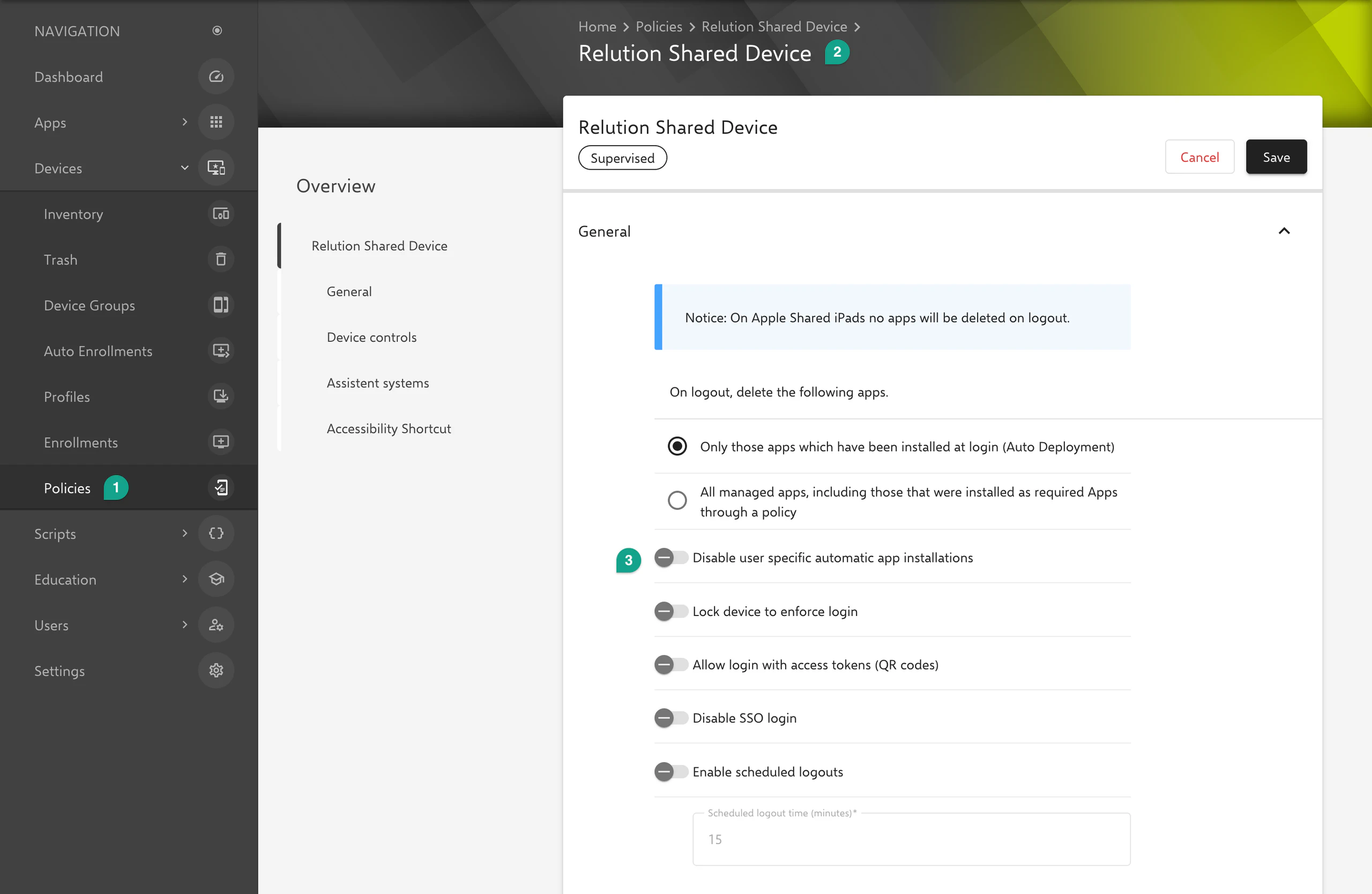
Whether the required apps are also deleted and downloaded again when the user changes is determined by the setting On logout, delete the following apps in the Relution Shared Device configuration:
- Only those apps which have been installed at login (Auto Deployment) (default): Only the apps installed via Auto Deployments and the apps from lessons are deleted. Required apps from the App compliance configuration remain on the device and do not cause another download at login.
- All managed apps, including those that were installed as required Apps through a policy: On logout, all managed apps except the Relution Agent are deleted. At login, the required apps that are configured for automatic installation are distributed again.
For slow Internet connections, the default option is the better choice. If Apple Shared iPad is used in addition, apps are not deleted on logout; apps that are already installed are not downloaded again when the user changes. The specifics of this combination are described in the article Multi-user mode →.
Minimize App compliance and Auto Deployments
If the option All managed apps, including those that were installed as required Apps through a policy is selected, the Required apps list in the App compliance policy configuration should be kept relatively small. A small base set of apps for all devices is usually sufficient. In this case, each required app is transferred through the network again on every user change, once for each device on which the policy applies. So 50 MB quickly becomes 5 GB when classes start.
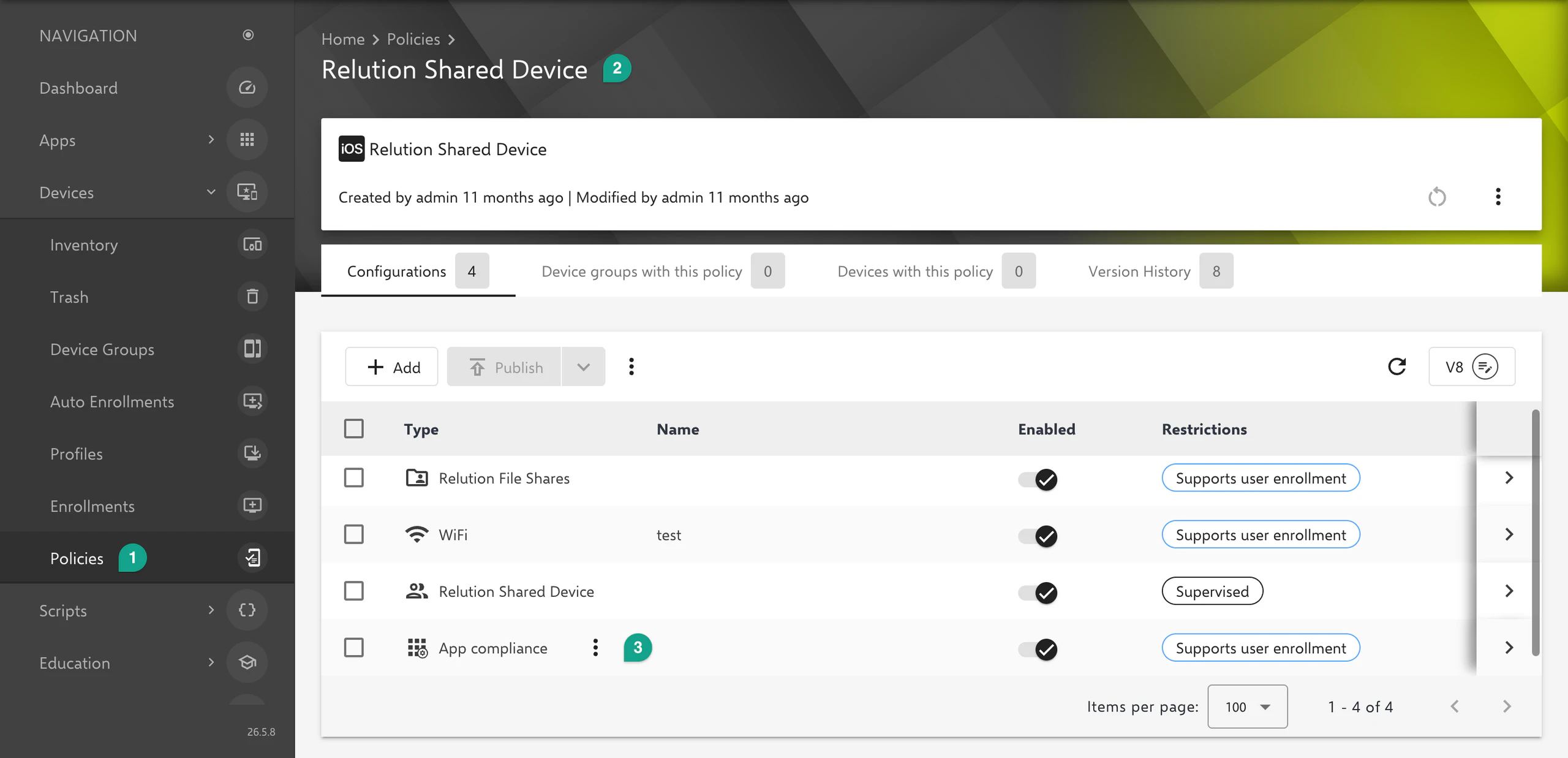
Apps from Auto Deployments are deleted on logout and installed again at the next login with both options. In addition, the Disable user specific automatic app installations switch can be turned on in the Relution Shared Device configuration. The apps assigned via Auto Deployments are then not installed at login, which speeds up the user change.
Alternatively, required apps can be installed on user devices later at any time via the Relution Agent.
Lesson templates via Relution Teacher
After following the above measure, if there are no or only a few apps stored in App compliance and Auto Deployments, teachers can use the Relution Teacher app and Lesson templates to predefine all required apps for the lessons. This way, only the apps needed for the particular lesson will be loaded.
If a user logs in while the device is part of an active lesson, the device is provisioned with the lesson data; the apps from Auto Deployments are not installed in this case. With the default option, the lesson apps are removed again on logout.