Customer Hub
Weblinks
Weblinks can be deployed as an app in Relution. This is useful if, for example, a weblink is to be deployed user- or group-specifically (auto deployments) or placed in the policy configuration Home Screen Layout.
1. Create Weblink
- Click on Add in Relution under
App Store. - Select Weblink.
- Click on Next.
- Enter the URL of the link.
- Click on Add details.
- Under Release status, select Release.
- Assign a name
- Optionally enable Open in full screen so that the weblink starts as a web app (see Open a weblink as a web app →)
- Click on Save in the upper right corner.
2. Deploy weblinks on iOS devices
Two ways are available for distribution, 2a or 2b. Regardless of the chosen way, the weblinks can then be arranged in the Home Screen Layout (3).
2a. Distribute Weblink via auto deployments
Weblinks cannot be deployed as Required apps in the App compliance policy configuration. However, it is possible to automatically deploy weblinks to specific users or user groups via Auto Deployments.
- Open the corresponding user account or group.
- Click the Add button at the bottom of the Auto Deployments section.
- Select the created web link and click Add. The auto deployment is saved immediately; saving the user or group form is not required.
The added web links will be immediately displayed on the devices where the corresponding user or a member of the corresponding user group has logged in.
2b. Provide a web link via the policy
Web links can also be provided with the configuration Weblink, for this purpose, a configuration via policies must be created as follows:
- In the page navigation, go to
Devices→Policies→Addor open an existing policy - Click on the button
Add→Weblink→Add detailsto create a weblink configuration - Label and URL (e.g.
https://relution.io) are mandatory. - Application to open weblink with: A third-party browser app can be selected here, e.g. Firefox. If no entry is made, Safari is used. For display as a web app, the field remains empty.
- Removable (enabled by default): The web link can be removed by the user.
- Precomposed icon (enabled by default): If enabled, iOS does not add any visual effects to the uploaded icon. The option dates back to older iOS versions that added a gloss effect to icons.
- Full screen (disabled by default): The web link starts as a web app instead of in Safari (see Open a weblink as a web app →).
- Icon: Optionally, a custom icon can be uploaded for the web link.
3. Optional: Arrange Weblink in Home Screen Layout
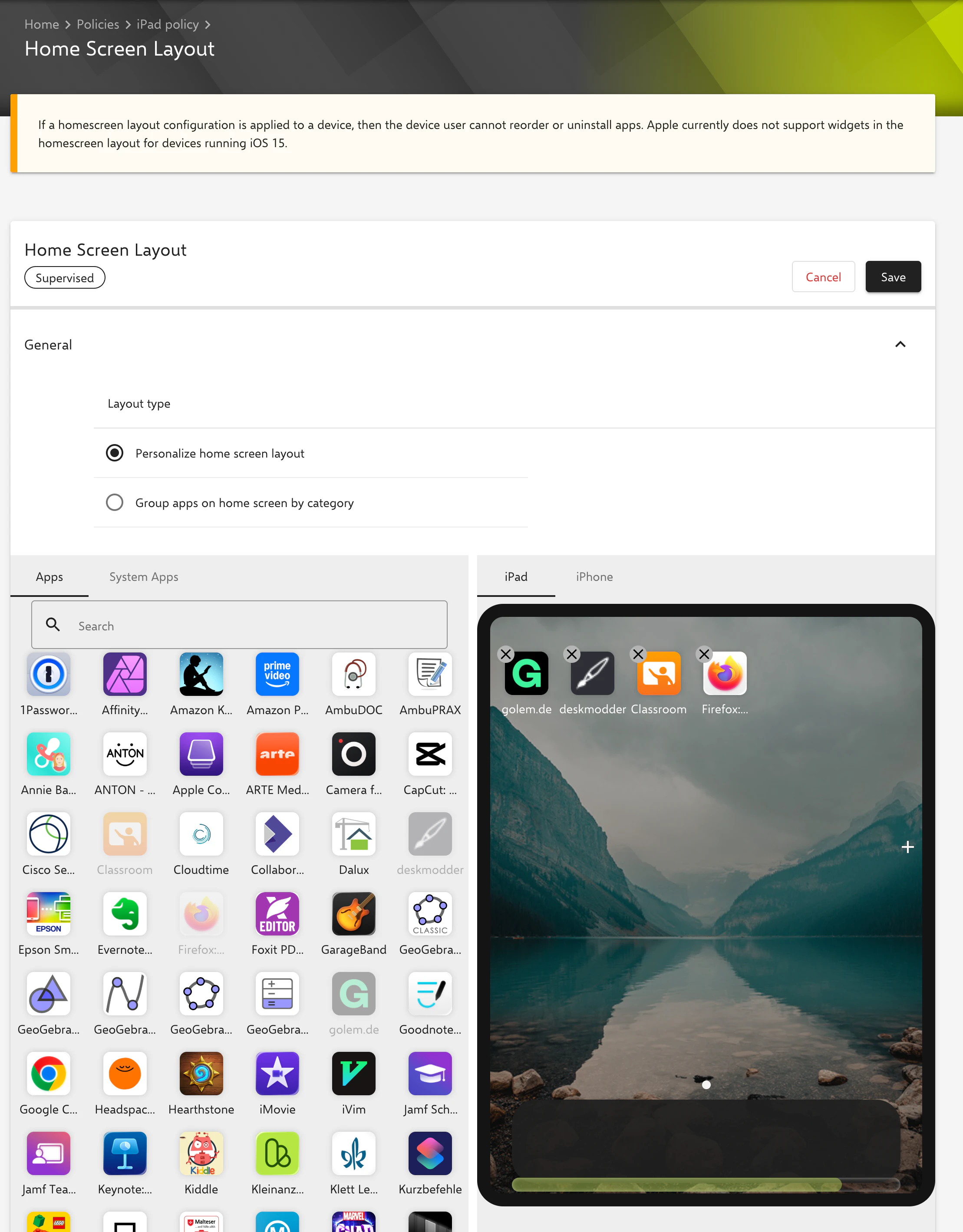
The policy configuration Home Screen Layout can be used to place apps and web links specifically on the home screen of iOS devices.
- Navigate to the menu item
Devices→Policiesin the Relution portal and click on Add. - Create an iOS policy and assign a name. Click on Save.
- After clicking Add, select
Home Screen Layoutoption and proceed to Add details. - If existing web links have previously been assigned to a category, they can be automatically placed in created folders on the home screen with the option Group apps on home screen by category (under Layout type); the editor is then locked. To arrange them manually, select Personalize home screen layout under Layout type.
- Then place the relevant apps and web links in the desired order using drag & drop.
- Click Save and publish the current version of the policy.
- To apply the policy to iOS devices, add the desired devices using the Devices with this policy tab. The selected settings will then be automatically applied to the devices.
Weblink configuration does not appear there.
On the device, the weblink only appears at the intended position if it was installed via 2a or 2b. With 2b, the URL in the Weblink configuration must be identical to the URL of the weblink in the App Store.Open a weblink as a web app
On the device, a weblink starts either as a bookmark in Safari or as a standalone web app. This is controlled by the option Open in full screen (weblink in the App Store) or Full screen (configuration Weblink in a policy):
- Option disabled: The weblink opens the page in Safari, with address bar and tabs.
- Option enabled: iOS starts the page as a web app in its own window without the Safari interface. In the app switcher it appears as a separate app.
Whether the page is actually displayed as a web app also depends on the website itself. It must support web app mode, e.g. via a web app manifest with "display": "standalone" or the meta tag apple-mobile-web-app-capable. Without this support, iOS displays the page as in Safari even if the option is enabled.
In the policy configuration, Application to open weblink with remains empty for display as a web app. If an app is selected there, the weblink opens in that app.
Web Links on Relution Shared Devices
Weblinks that are distributed to the user via auto deployment (see 2a) are allowed automatically by Relution Shared Device after login, including Safari. This applies without an app compliance policy and with an app compliance policy whose List type is set to Blocklist — The apps below are not allowed, as long as Safari is not on that list.
A suitably configured App compliance → policy is required if:
- the devices are assigned an app compliance policy with List type set to Allowlist — The apps below are allowed (the default for Weblinks is Don’t allow weblinks; Put all auto-deployed apps on the allowlist does not allow weblinks either), or
- the weblinks are only distributed via the
Weblinkconfiguration in a policy (see 2b).
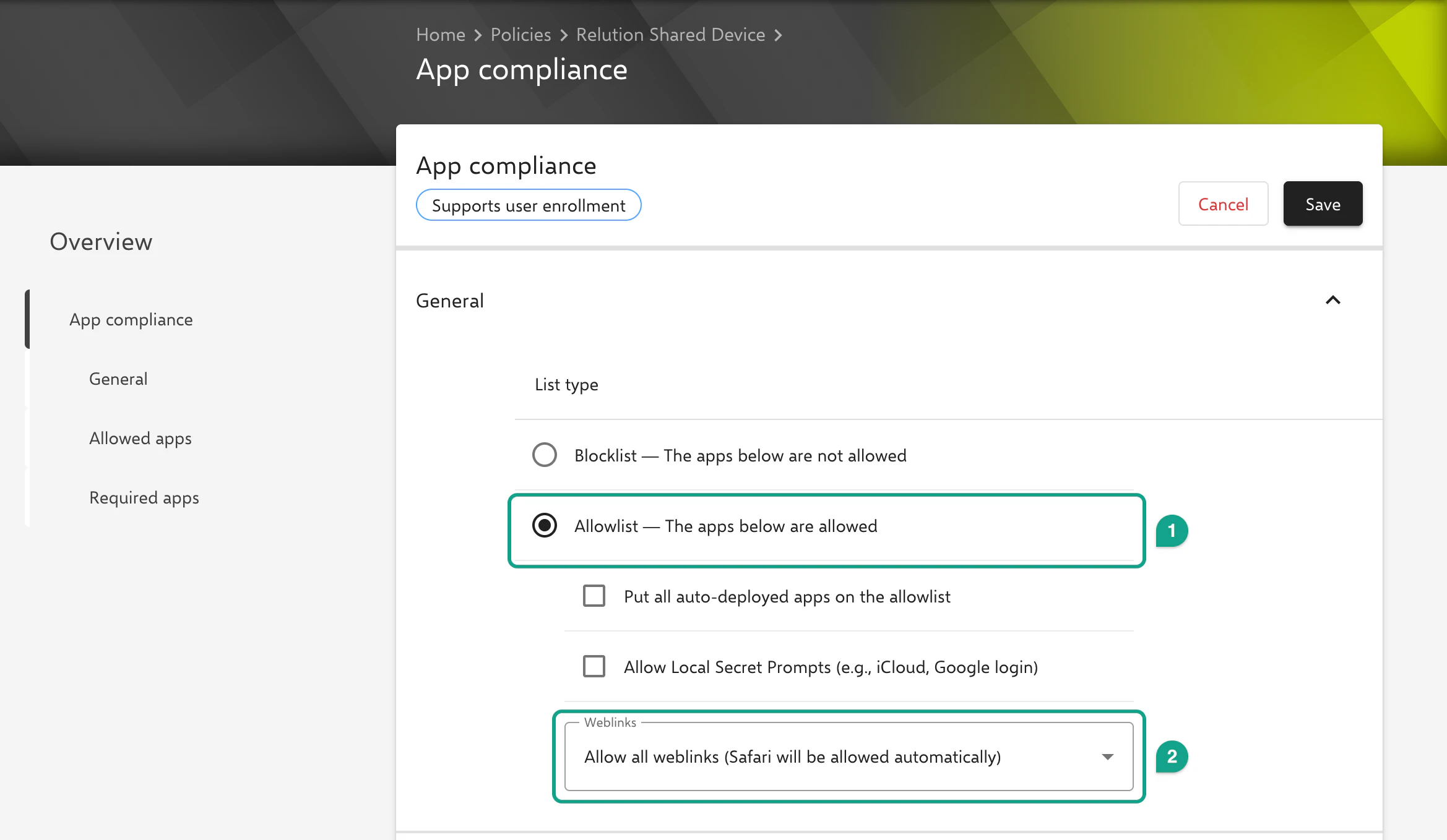
The app compliance policy then needs the following settings:
- Set List type to Allowlist — The apps below are allowed
- Set Weblinks to Allow all weblinks (Safari will be allowed automatically). The field only appears if Allowlist — The apps below are allowed is selected under List type. If only full screen weblinks are used (see Open a weblink as a web app →), Allow all full screen weblinks is sufficient; Safari then remains blocked.