 Customer Hub
Profile for ADE
If Apple devices are to be enrolled via Automated Device Enrollment (ADE, DEP in the portal), a profile (formerly DEP profile) is used. This profile is transferred from Relution to the Apple server and is applied to the devices before the actual enrollment.
A profile can only be created if ADE (formerly DEP) is set up in the Relution organization and a valid DEP token is on file.
New profiles are created under Devices → Profiles via Create. If other types of auto enrollment are set up as well, the profile type is requested first; DEP is selected there. This area also provides an overview of existing profiles.
Use as default profile makes a profile the default profile. It is automatically assigned to new auto enrollments that do not have another profile assigned yet. For devices with an active MDM migration, this only happens if Await configuration and Preserve all installed apps are enabled in the default profile. It is recommended to define a default profile. The name of the profile should be meaningful so that it can be easily identified.
Agreements allows selecting agreements that were created under Settings → General → Agreements. Relution provides their texts to the device during enrollment. The selection is only shown to users with read permission for agreements.
The Default device name (up to 255 characters) is applied to the devices in the Auto Enrollments during enrollment. Placeholders can also be used and combined here, see Advanced placeholders →. The fields Support phone number, Support email address, Department name (up to 125 characters) and Authentication prompt (up to 255 characters) contain information that is displayed during enrollment.
Force MDM enrollment
This option makes it mandatory for devices to be enrolled during startup. There is no option to skip or cancel the enrollment process. For example, if devices are stolen, they cannot be put into service without MDM enrollment.
User authentication during enrollment
New in 26.4The User authentication field determines whether and how users must authenticate during enrollment. Three options are available:
- Disabled: No user authentication takes place.
- Username + Password: Enrollment must be authenticated with a Relution user account. An Apple Account is not necessary for this and is not supported here.
- Username + Enrollment Code (as of version 26.4): Instead of a password, a one-time enrollment code generated by Relution is requested.
If devices are assigned to individual users in the Auto Enrollments list, only they will be able to authenticate and put the corresponding devices into operation.
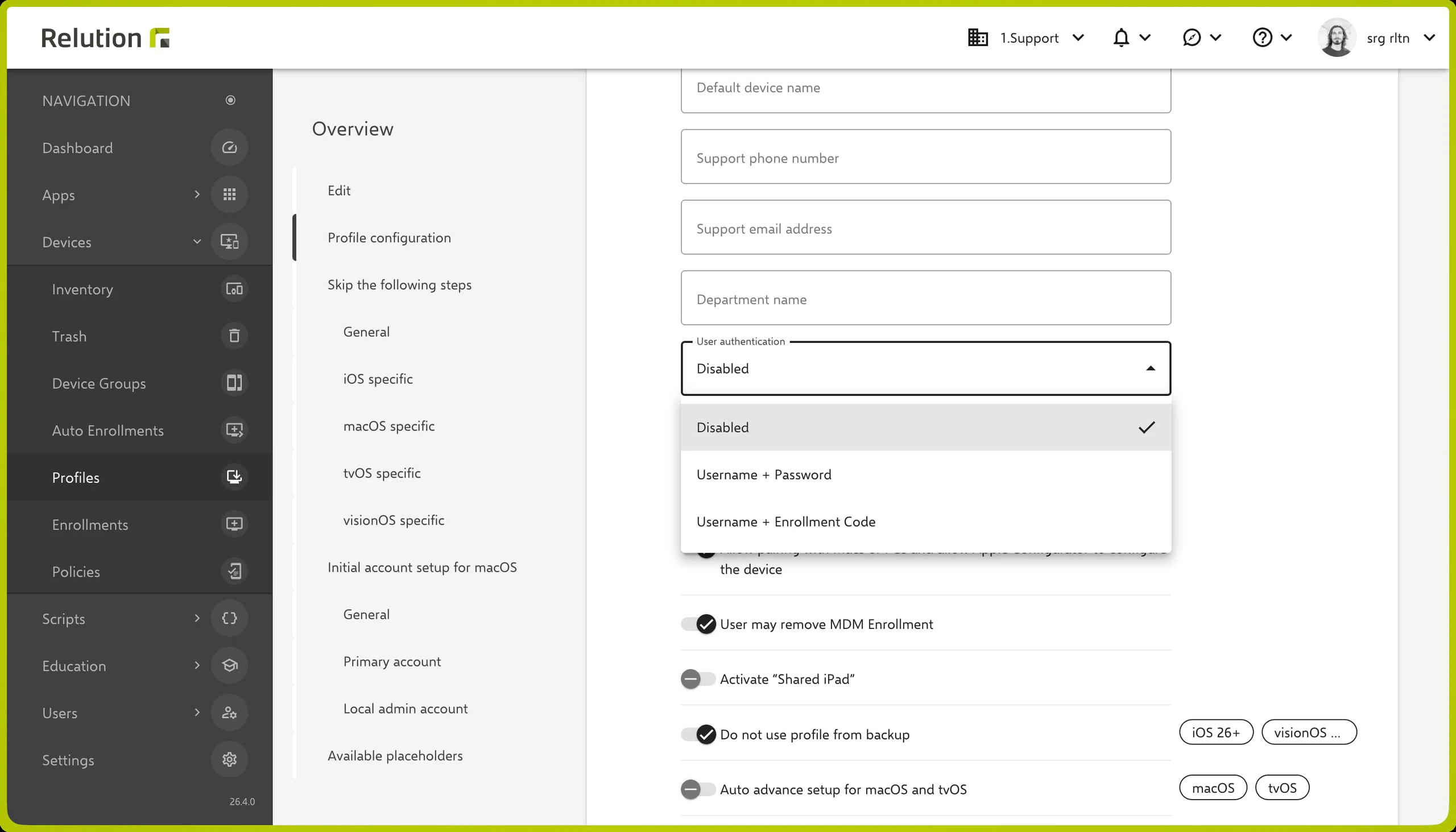
With Username + Enrollment Code, the email address of the assigned user is also accepted instead of the username. The eight-character code can only be used once and becomes invalid after more than five failed attempts. If the sign-in page is opened again, Relution generates a new code and sends it.
Allow pairing with Macs or PCs and allow Apple Configurator to configure the device
This option is enabled by default; if it is disabled, the portal displays a warning. If this option is deactivated, it will not be possible to connect to a PC or Mac later, e.g. to copy photos or create a backup of the devices. It is recommended to enable this option and to prohibit the connection with computers in the restrictions, if this is desired. The advantage is that restrictions in the policies can be changed at any time. The profile, on the other hand, cannot. In this case, the devices would have to be mandatorily reset to change the option.
User may remove MDM enrollment
If the option is enabled, users on devices can remove the MDM profile and thus the manageability by Relution.
This option is enabled by default for new profiles. To prevent users from removing the MDM profile, the option must be disabled before the devices are enrolled; changing it later requires a factory reset of the devices.
Enable Shared iPad
The Activate “Shared iPad” option is the only way to enable Apple’s multi-user mode Shared iPad. If this option is enabled, all the checkmarks set below for the setup steps to be skipped become redundant, as they will be skipped automatically.
Do not use profile from backup
This option applies to devices running iOS/iPadOS 26 or visionOS 26 and later. If it is enabled, the device does not use the profile contained in the backup when it restores a backup. Details on moving devices via backup: Backup and transfer to a new device →
Auto advance setup for macOS and tvOS
If this option is enabled, the Setup Assistant on macOS and tvOS devices automatically advances through its screens. The device needs an Ethernet connection for this. As long as the option is enabled, the setup steps to be skipped cannot be selected.
Await configuration
If Await configuration is enabled, the device remains in Setup Assistant until all apps and configurations have been installed. The device action Continue in device Setup Assistant informs the device that the pre-configuration is completed and it can proceed in the Setup Assistant.
The Preserve all installed apps option is only available together with Await configuration and is enabled by default. It is required to preserve managed apps and their data when migrating managed devices between MDM servers.
Minimum OS version
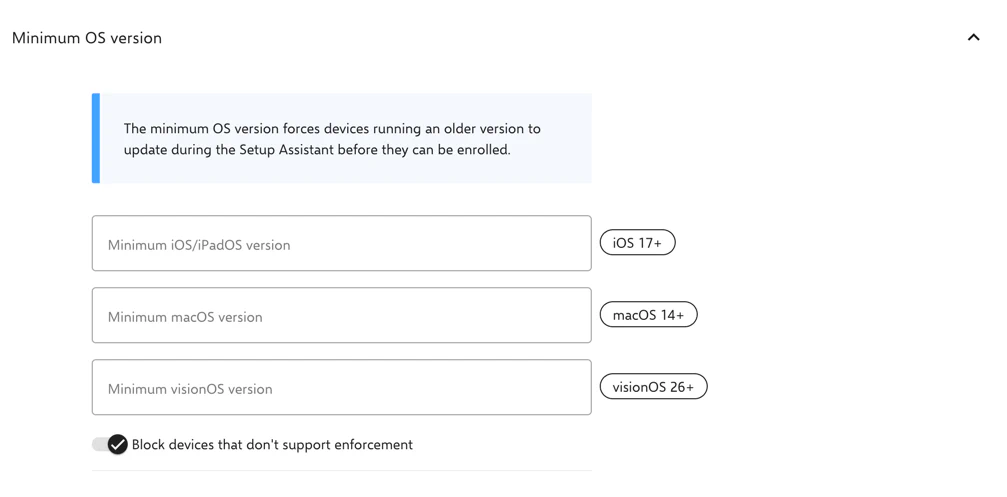
New in 26.5The Minimum OS version option requires devices to first update to a specific OS version during the Setup Assistant before they can be enrolled. A minimum version can be set independently for each platform:
- Minimum iOS/iPadOS version
- Minimum macOS version
- Minimum visionOS version
If a field is left blank, no minimum version is enforced for that platform. tvOS is not supported by this feature.
If a device already meets the configured minimum, enrollment is unaffected. If a device reports a version below the configured minimum during enrollment, it is first asked to update within the Setup Assistant. Enrollment continues only once the update has completed and the Setup Assistant has run again. Relution automatically requests the lowest version currently offered by Apple that satisfies the minimum requirement — not necessarily the latest available version. This enforcement also requires the device to be able to be asked to update in the first place, which Apple supports from iOS/iPadOS 17, macOS 14, and visionOS 26 onward.
The Block devices that don’t support enforcement option (enabled by default) determines how devices are handled that cannot be asked to update during enrollment, for example because they run too old an OS version. If enabled, such devices are prevented from enrolling. If disabled, such devices are enrolled without applying the minimum OS version.
Skip the following setup steps
Any options that are enabled, will be skipped during initial device setup.
Setup steps that are shown again after the initial setup, e.g. after a software update, are not covered by this. They can be hidden via the configuration Setup Assistant in a policy, see Setup Assistant (iOS) → and Setup Assistant (macOS) →.
If Location Services is not enabled, the step is shown during setup. There, device location can be allowed so that devices automatically set the correct time zone. The option only affects the Setup Assistant and has no influence on later device location tracking.
Initial account setup for macOS
In this section, user and administrator accounts can be added to macOS devices, which are automatically created at startup. Placeholders are also available here, see Advanced placeholders →.