 Customer Hub
Teacher
The Relution Teacher App (iOS, Android & Windows, and since Relution 5.24 also as a web app) allows teachers to create lesson-specific profiles with which apps, device functions, and web links can be prepared and managed for lessons.
It also enables the definition of participant groups and the control of lessons.
Thanks to integration with Apple Classroom and Samsung Classroom Management → (separate license required), comprehensive control is also possible during lessons – completely without an Apple Account on student devices.
Prerequisites for use
To use the Relution Teacher App, a Relution Education license is required.
In addition, classes with the corresponding students and teachers should be created (Education → Classes).
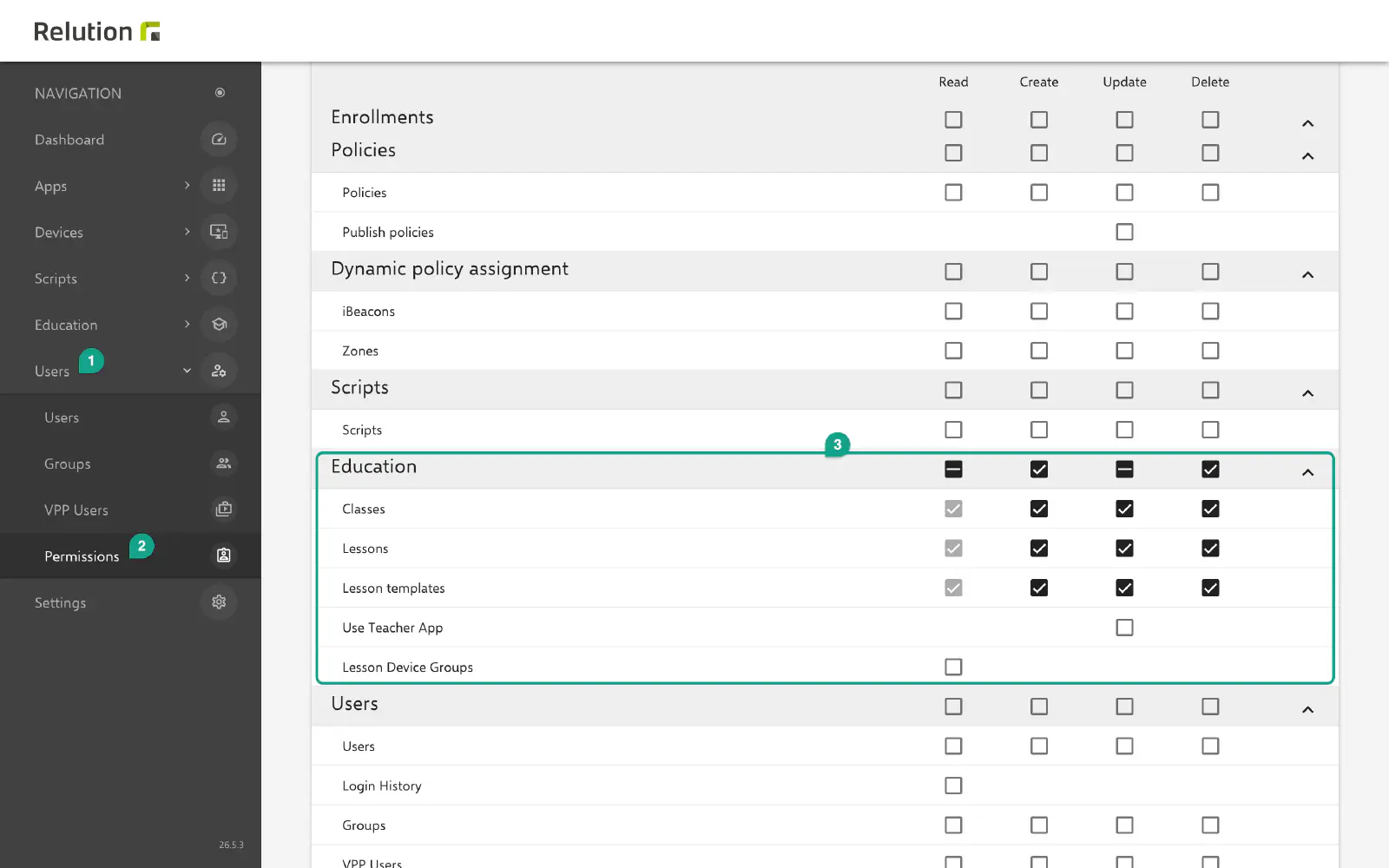
The teacher requires at least the Education → Use Teacher App permission. It is included in the system group [organization unique name] Teacher (e.g. UIT Teacher), which is assigned in the user account under Groups & Permissions in the Groups field; alternatively, it can be granted via a role in the Permissions field.
iOS, Android Enterprise and ChromeOS devices are supported as student devices.
Structure
The content for the student device is defined by a profile. In addition, participants are defined and the duration is set. The lesson can then be started.
Profiles
Profiles define what the device is equipped with for the lesson.
The teacher can choose between private and public profiles. The latter can be used by all teachers in the organization. Editing and deletion remain reserved for the creator.
For the exam profile (iOS, ChromeOS), the wallpaper is additionally set.
Apps, web links, system apps, and certain restrictions can be defined in the profile.
Apps should not be installed only when the profile is applied in order to minimize setup time for the lesson. When using exam mode, a default wallpaper should be set in a separate policy. To keep students permanently in Wi-Fi or prevent disabling Bluetooth, a separate policy is also recommended.
Managing participants
For the lesson, a preconfigured class can be selected. Missing students can be removed directly from the lesson. This ensures that the profile is only distributed to the devices of present students.
Alternatively, an ad-hoc class can be created. In this case, all students of the organization are available for selection.
For recurring ad-hoc groups, it is recommended to define custom classes via the portal or assign students to multiple classes.
Setting lesson duration
A profile is time-limited – e.g., until the end of the current lesson.
Under Lesson Settings →, individual lesson times can be configured.
Starting and controlling lessons
Only one lesson per teacher can run at a time. When a lesson is started, other unfinished lessons of the same teacher are ended or deleted. If students are already taking part in another active lesson, a notice appears; if the lesson is started anyway, they are removed from the other lesson.
If the Limit lesson to timetable option is enabled in the Lesson Settings →, lessons cannot be started outside the timetable.
During a running lesson, teachers can adjust participants, change the remaining time, and manually end the lesson. When ending the lesson, shared iPads (Shared iPad) can be signed out; during a running lesson, this is also possible for individual shared devices.
The profile is removed from student devices after the defined time has elapsed or when the lesson is ended.
When the lesson is ended manually, Relution sends the changes to the student devices immediately; after the defined time has elapsed, within about one minute. Blocked websites and lesson restrictions are lifted as soon as the change reaches the device. If a device is not reachable at that time, it receives the change as soon as it is reachable again. Apps installed for the lesson are not uninstalled in the process.
Creating lesson templates
Lessons can be saved as personal or shared templates to reuse them quickly.
A lesson template includes the following settings:
Type of lesson template
- Personal template (private)
- Use only for the creator of the template
- Shared template (shared)
- Use of the template for all teachers
Private templates without an owner (e.g., after the teacher has been deleted) are deleted automatically every day at 01:00.
Exam mode (iOS, ChromeOS)
- Exam mode
- Sets a purple wallpaper with the text “Klausur” (or “Exam” if the server’s default language is English) on the students’ iOS and ChromeOS devices, so that it is clear at a glance whether the device is in the desired state.
- On iOS, the wallpaper cannot be changed during the exam, and Spotlight search does not show internet results.
- After the exam ends, Relution sets a default wallpaper. On iOS, this does not happen if a policy already defines a wallpaper for the lock and home screen.
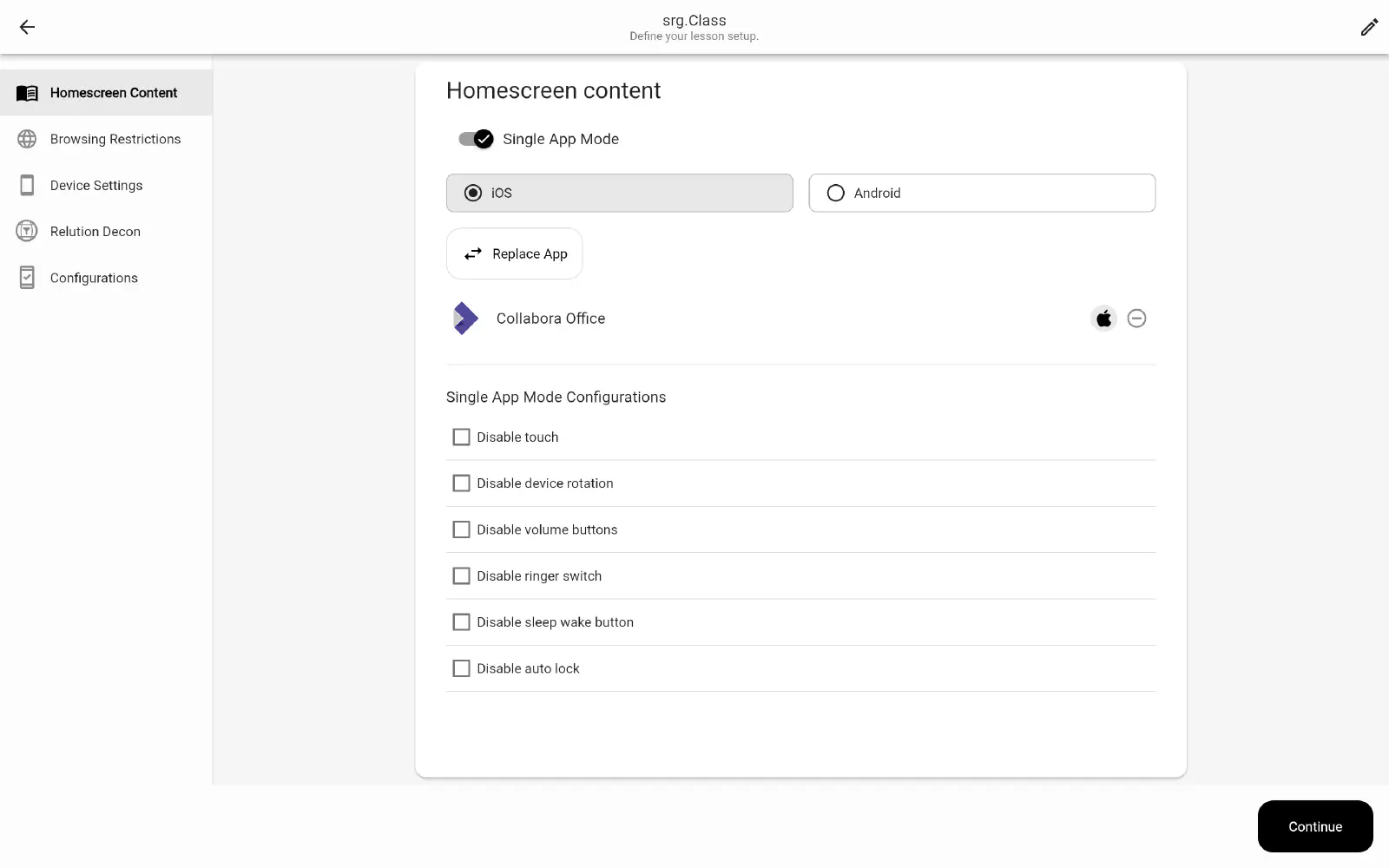
Single app mode
- Puts the device (Android or iOS) into single-app mode.
- Exactly one app must be selected in the lesson for this.
- In addition, device functions can be restricted in single app mode, e.g. touch, rotation, volume buttons, ringer switch, sleep/wake button and auto-lock on iOS, and e.g. power button, system navigation, status bar, device settings and keeping the screen on while charging on Android.
Apps allowed during the lesson
- Here a selection of apps can be defined that are available to students during the lesson.
Device functions during the lesson
- Allow camera (Android + iOS)
- Allow screenshots (Android + iOS)
- Show Safari and web links (iOS)
- Use web links to filter web content (iOS)
- Show Messages app (iOS)
- Allow spelling assistance (iOS)
- Allow AirDrop (iOS)
- Enforce Bluetooth (iOS)
Alternatively, it can be specified that no lesson-specific restrictions are applied for the lesson.
Web links and browsing restrictions
New in 26.5Web links can be used in a lesson template in two independently configurable ways:
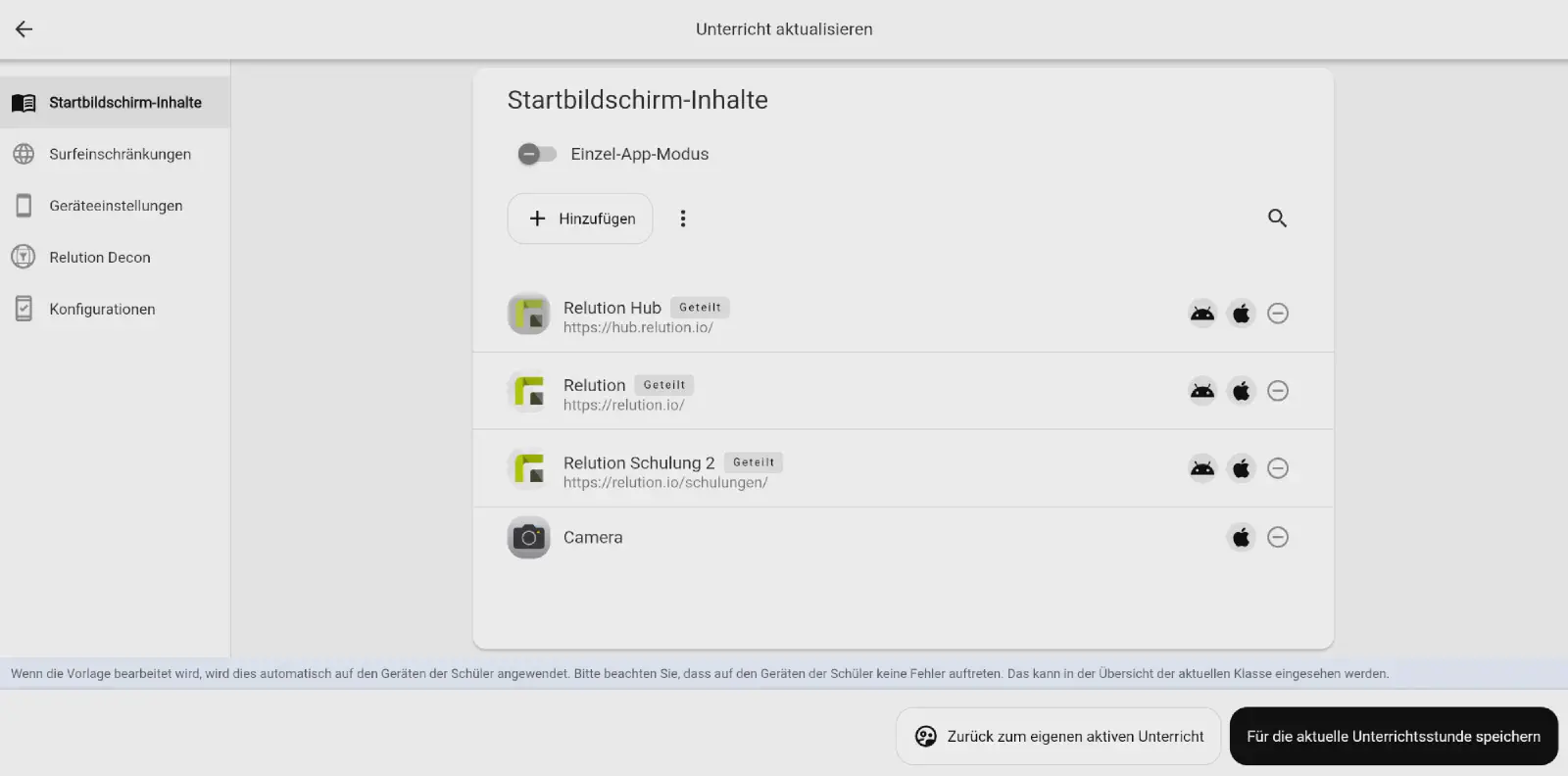
- Under Homescreen content, web links are placed as shortcuts on the students’ home screen for the duration of the lesson. Further web links can be added via Add.
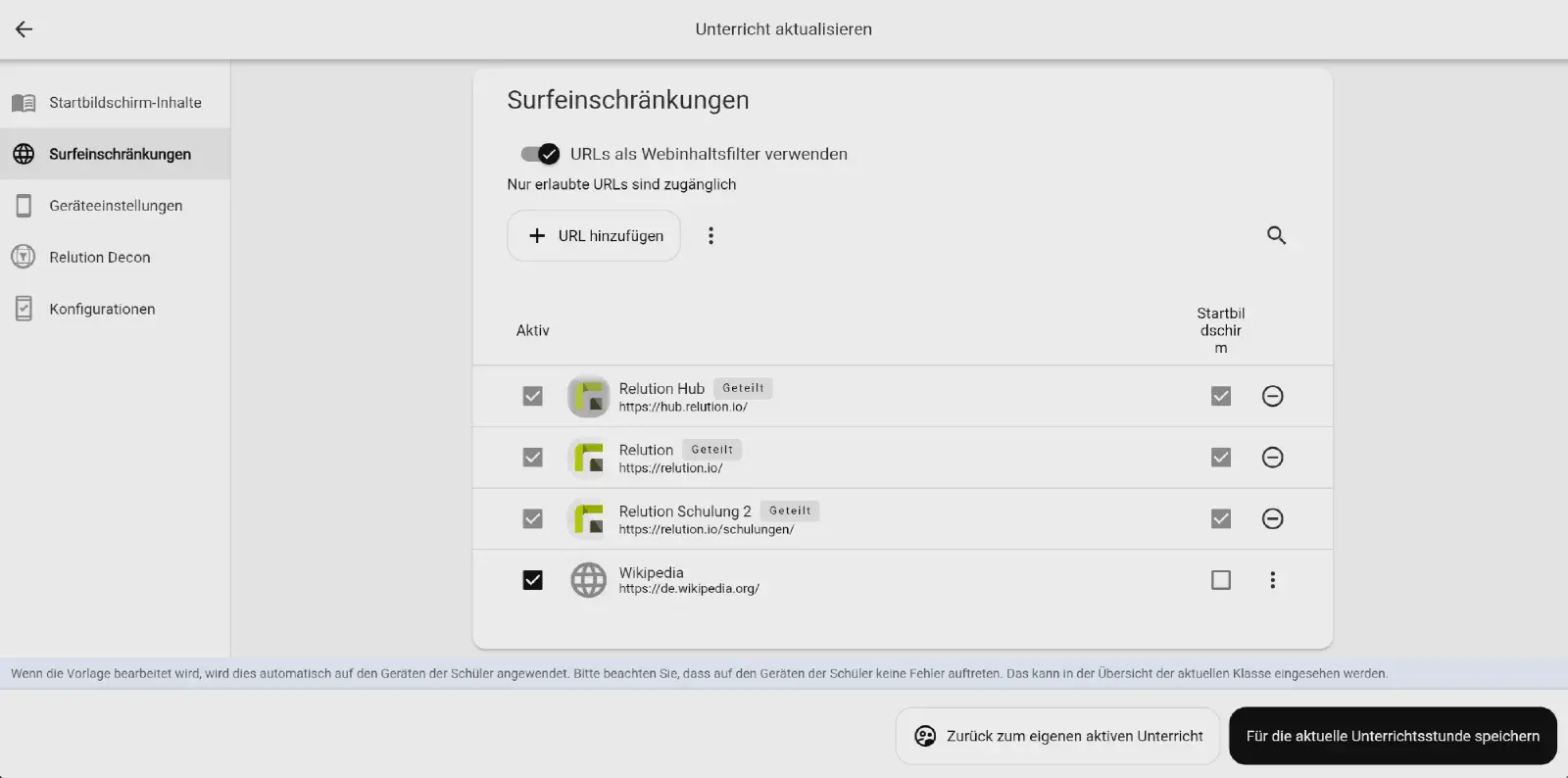
- Under Browsing Restrictions, URLs act as an allow list for the web content filter (iOS). The Use URLs as web content filter toggle enables filtering. When it is switched off, browsing is unrestricted and the listed URLs have no effect.
In the browsing restrictions list, the Active column defines for each URL whether it is allowed in the web content filter, and the Home Screen column whether it additionally appears as a shortcut on the home screen. An entry can thus serve purely as an allowed URL without appearing on the home screen. When the web content filter is enabled, an inactive URL does not appear on the home screen either. URLs can be added directly via Add URL; web links already created under Homescreen content can also be adopted.
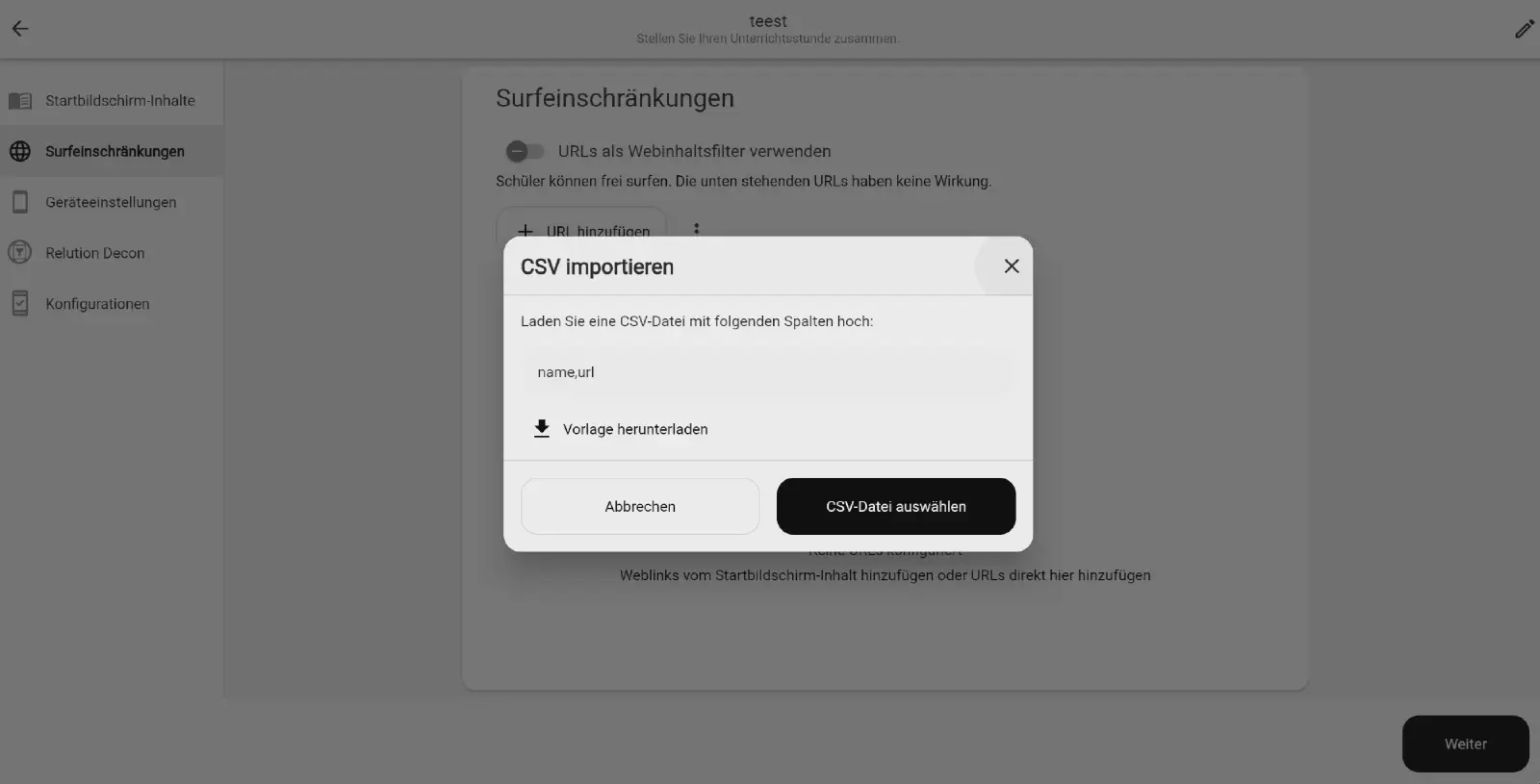
Importing web links via CSV
Using the three-dot menu → Import CSV, a list of web links can be uploaded as a CSV file. The file contains the columns name and url; a matching template is available via Download template.
name,url
Wikipedia,https://wikipedia.org
App Store settings
- Allow Google Play Store (Android)
- Show App Store (iOS)
- Show iTunes Store (iOS)
Relution Decon
- Enable Relution Decon (license required. In addition, a Decon policy must be assigned to student devices in Relution)
- BPjM list
- Safe search
- Filter type
- Off
- Age restriction
- 0+
- 6+
- 12+
- 16+
- Categories
- Adult content
- Advertising
- Communication
- Social media
- Entertainment
- Music
- News
- Shopping
- Work
- Education
- Generative AI
- Phishing
- Miscellaneous
More about Relution Decon →
In addition, separate lists of allowed and blocked websites can be defined for the lesson. The active web links of the lesson are automatically adopted as allowed websites. The Categories filter type and the 12+ age level are preset.
Note: For the duration of the lesson, the otherwise active Decon configuration is overridden.
Configurations
In Relution Teacher, Configurations are the education groups that have been created and assigned policies in the portal: Education groups →.
In the lesson template, one or more configurations can be selected in the Configurations area; the name, description and linked policies are shown for each. When the lesson starts, the linked policies are applied to the student devices and removed again when it ends.
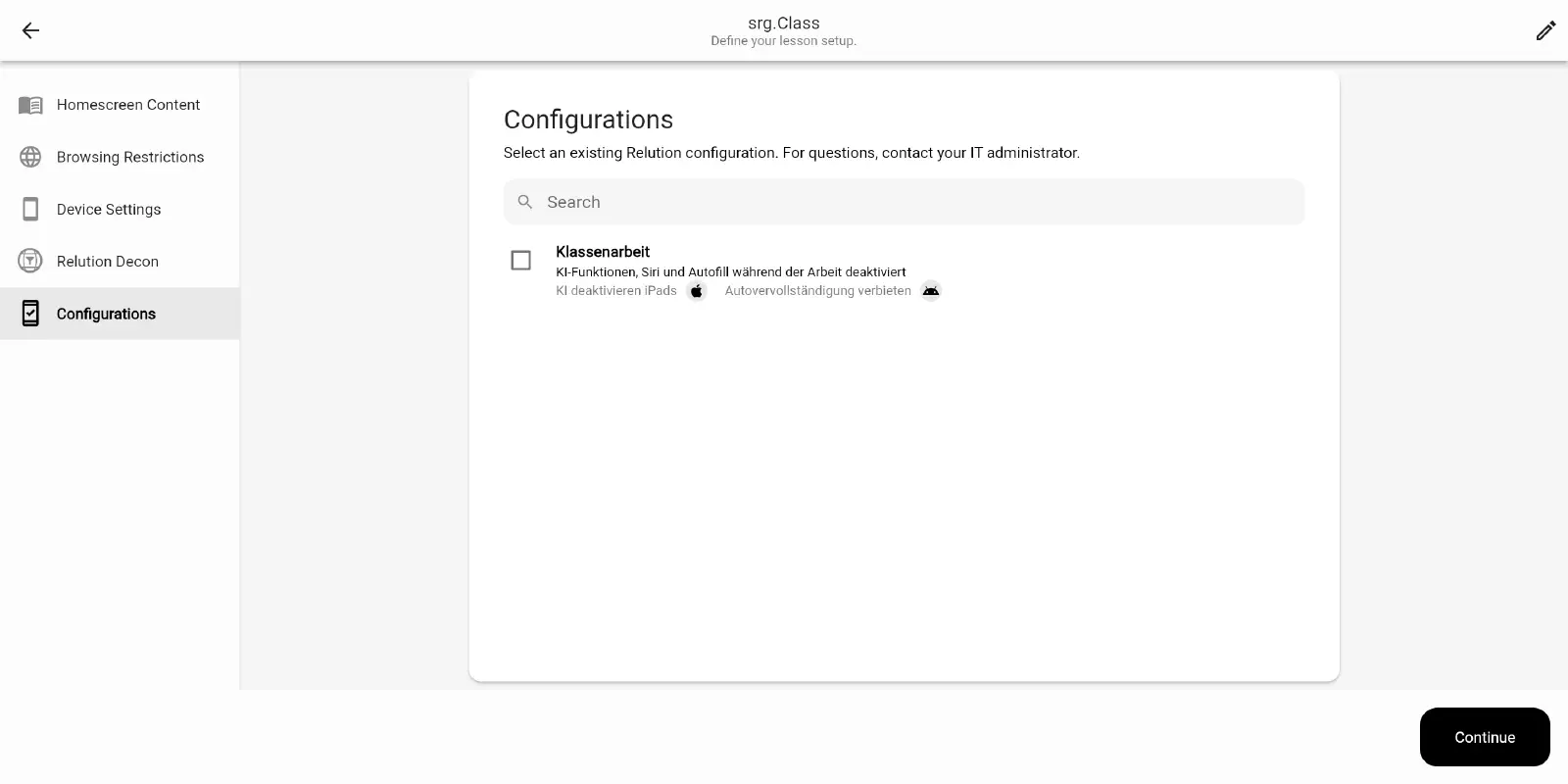
Selecting configurations requires the read permission Education → Lesson Device Groups. Without this permission, no configurations are displayed.
Admin mode for lesson overview
For the admin view in the app, at least read permission Education → Lessons is required.
The admin has access to all lessons in their organization. These can be viewed and additional information can be obtained in case of issues.
With the Update permission for Education → Lessons, the lesson can be edited (add/remove students) and ended early.
Relution Teacher as a web app
Since Relution Server 5.24, the Relution Teacher web app is available.
Teachers can now create, start, and control lessons directly from a browser window in the same way as on iOS and Android.
This seamless integration enables smooth and efficient lesson organization that meets the requirements of modern educational environments.
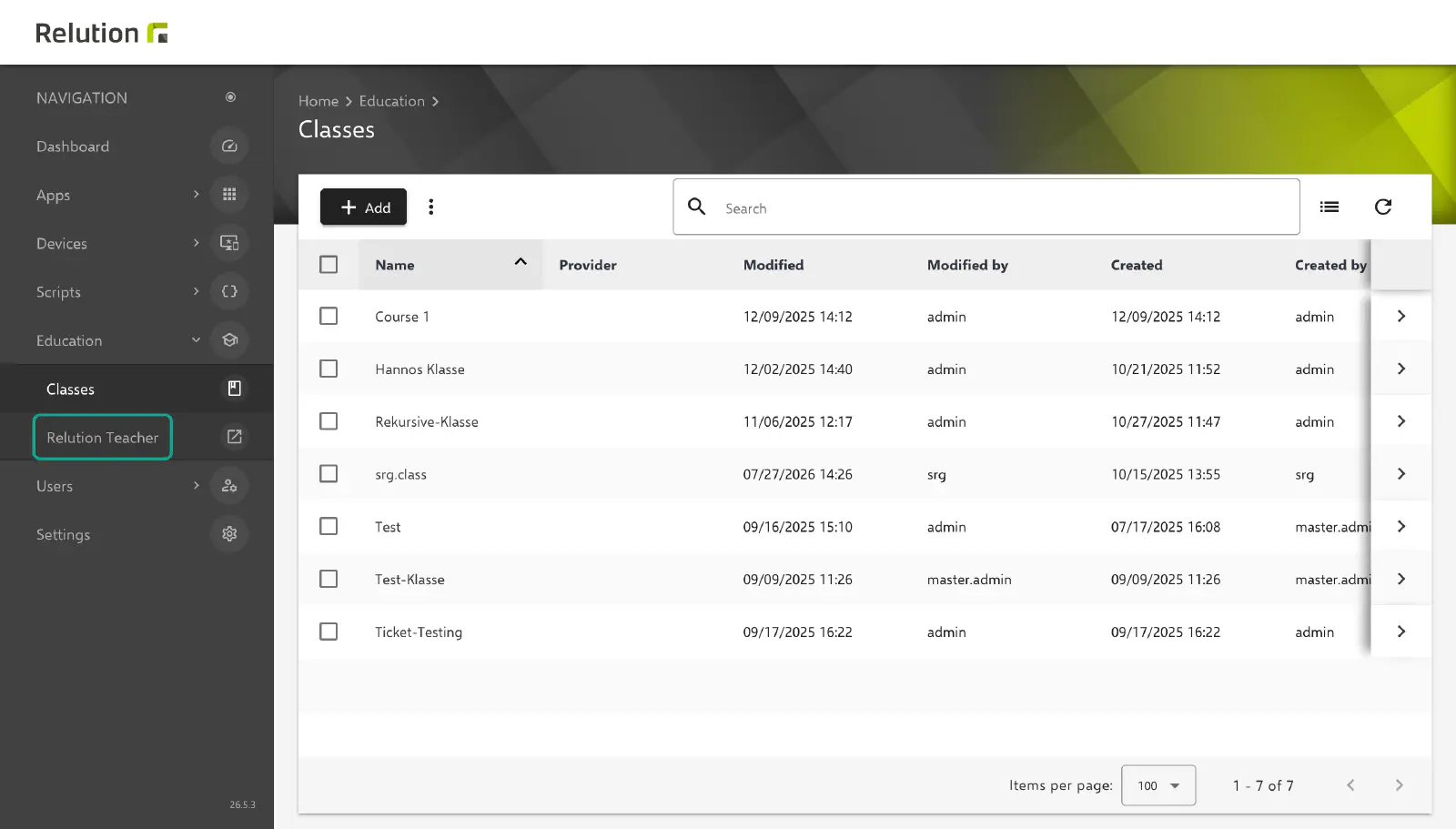
The web app is accessible in the navigation menu under Education → Relution Teacher and opens in a new browser tab. The menu entry only appears with the Education → Use Teacher App permission.
Multitenant feature for teachers with multiple schools
The multi-tenant capability of Relution Teacher allows teachers to extend the functionality of Relution Teacher across multiple organizations.
This is especially useful when teachers work at multiple schools that manage their student devices via the same Relution instance.
Configuration
To enable access to multiple Relution organizations, the following steps are required:
- The login takes place in the
Globalorganization. - In the Relution portal, the corresponding user (teacher) is searched for and edited in the
Userssection. - The user is added to the system user groups of the additional organization(s), e.g. the [organization unique name] Teacher group.
After configuration, the desired organization can be selected in the Relution Teacher App as well as in the Relution Teacher web interface via the side menu. Only organizations in which the teacher has the Education → Use Teacher App permission are available for selection.
Additionally, in the Global organization under Education → Classes, the Organization column shows which Relution organization each class belongs to.
Note
When applying a lesson via Relution Teacher, the user’s individual home screen layout is discarded.
Technically, it is currently not possible to save the user’s app arrangement and reapply it after the lesson ends.
It is possible to centrally define a layout via Home Screen Layout configuration so that a consistent state can be enforced across all devices.