 Customer Hub
Self-Service Portal
As of version 5.22, Relution has a self-service portal. Here Relution users can view their own devices, carry out individual actions and request details.
Requirements
Two default permissions are available for using the self-service portal. They are created automatically during an update to Relution 5.22 or when the database is created. To make the Self-Service Portal available to users, they must have the appropriate permission and have linked at least one device to their user account.
Granting permissions
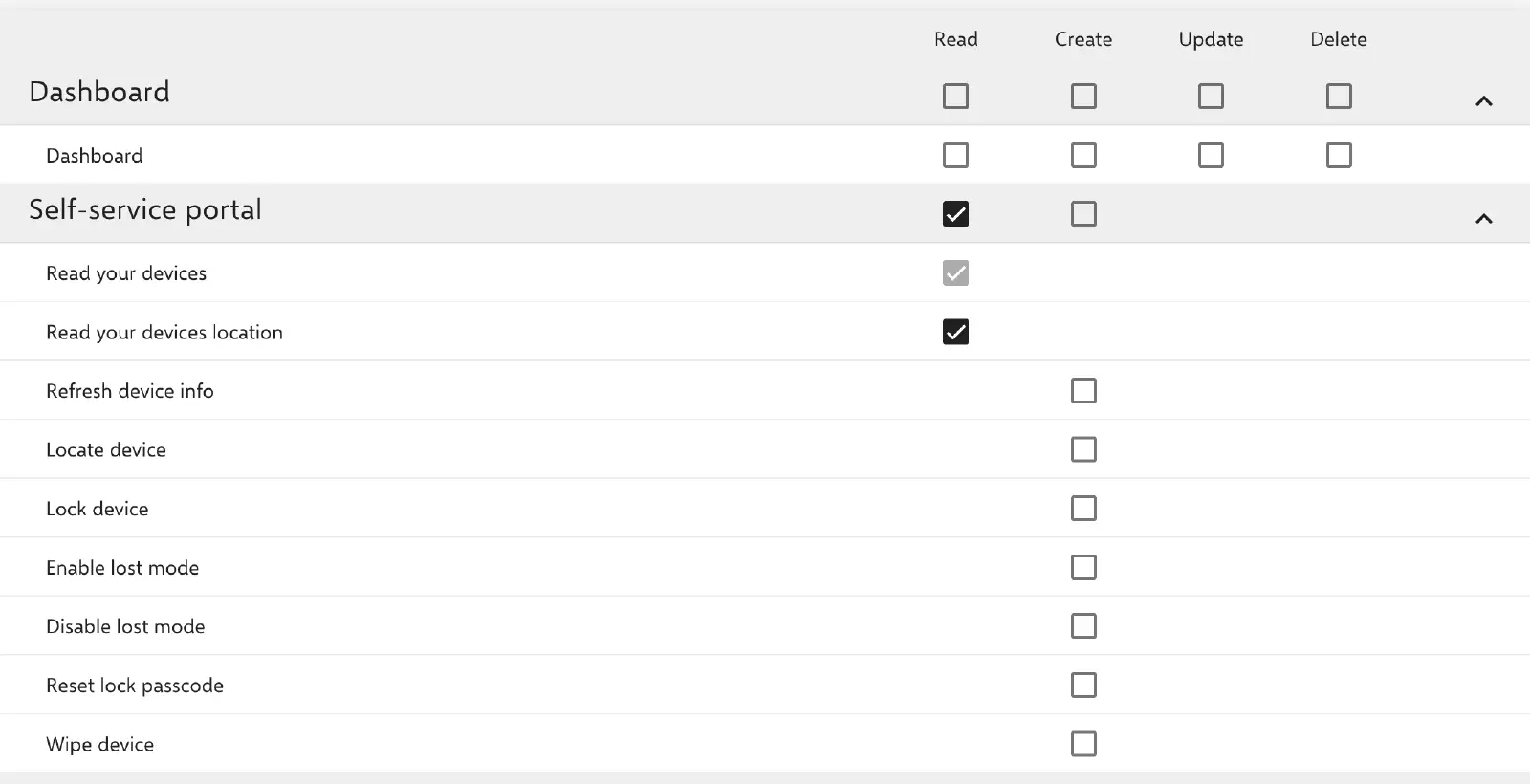
Under Users → Permissions, Self service portal - full access and Self service portal - read access are available as templates. Depending on the requirements, these must be linked to the desired accounts.
Self service portal - read accessonly allows viewing the user’s own devices and refreshing their device information.Self service portal - full accessadditionally allows reading the location, locating the device, enabling and disabling lost mode, locking the device, resetting the lock passcode, and wiping or deleting the device.
For custom permissions, the individual rights are available in the Self-service portal category, e.g. Read your devices, Read your devices location and a separate right for each action.
The assignment is done as follows:
- Under
Users→Users, the relevant user account is opened. - In the Direct Memberships area under Groups & Permissions, Manage Permissions in the Permissions field opens the selection.
- One of the above permissions is selected there.
- Save applies the assignment.
Linking a device to the user account
A user account can be linked to a device either by importing a CSV file, by configuring the enrolment accordingly before enrolment or manually.
For the manual method, it is only necessary to select the device from the inventory and select the Change device user icon from the toolbar.
The Self-Service Portal
If a person logs in to the Relution portal with the corresponding user account, the self-service function is available. Users who only have self-service permissions are taken directly to the Your devices page after signing in; administrators reach it via the profile menu at the top right.
Since Relution 26.5.0, signing in to the Self-Service Portal uses a dedicated scope (/api/selfService/). If OpenID Connect with scoped redirect URIs is used for this, the corresponding redirect URI must be registered with the identity provider, see OIDC with Entra → or OIDC with Workspace →.
For each device, basic information is displayed, e.g. battery status, status, last connection, platform, owner, model, serial number, operating system, enrollment date and lost mode status. The following functions are also available:
- Enable / disable lost mode
- Locate device
- Show location on a map
- Wipe device
- Lock device
- Reset lock passcode
Wipe device opens the Remove dialog. There, a choice is made between resetting the device to factory settings and Delete (removing the device from the MDM). The Refresh device informations of all visible devices button on the Your devices page queries the information of all displayed devices again; by default, a new query is possible at the earliest 5 minutes after the last refresh.
The available functions may vary depending on the device platform. On iOS devices, lost mode and locating are only available on supervised devices, and locating additionally only while lost mode is enabled. While a device is being deleted or retired, the actions are locked. The functions can also be restricted via permissions.
Show location on a map
New in 26.4Users with the corresponding permission can display the last known location of their device directly on a map.
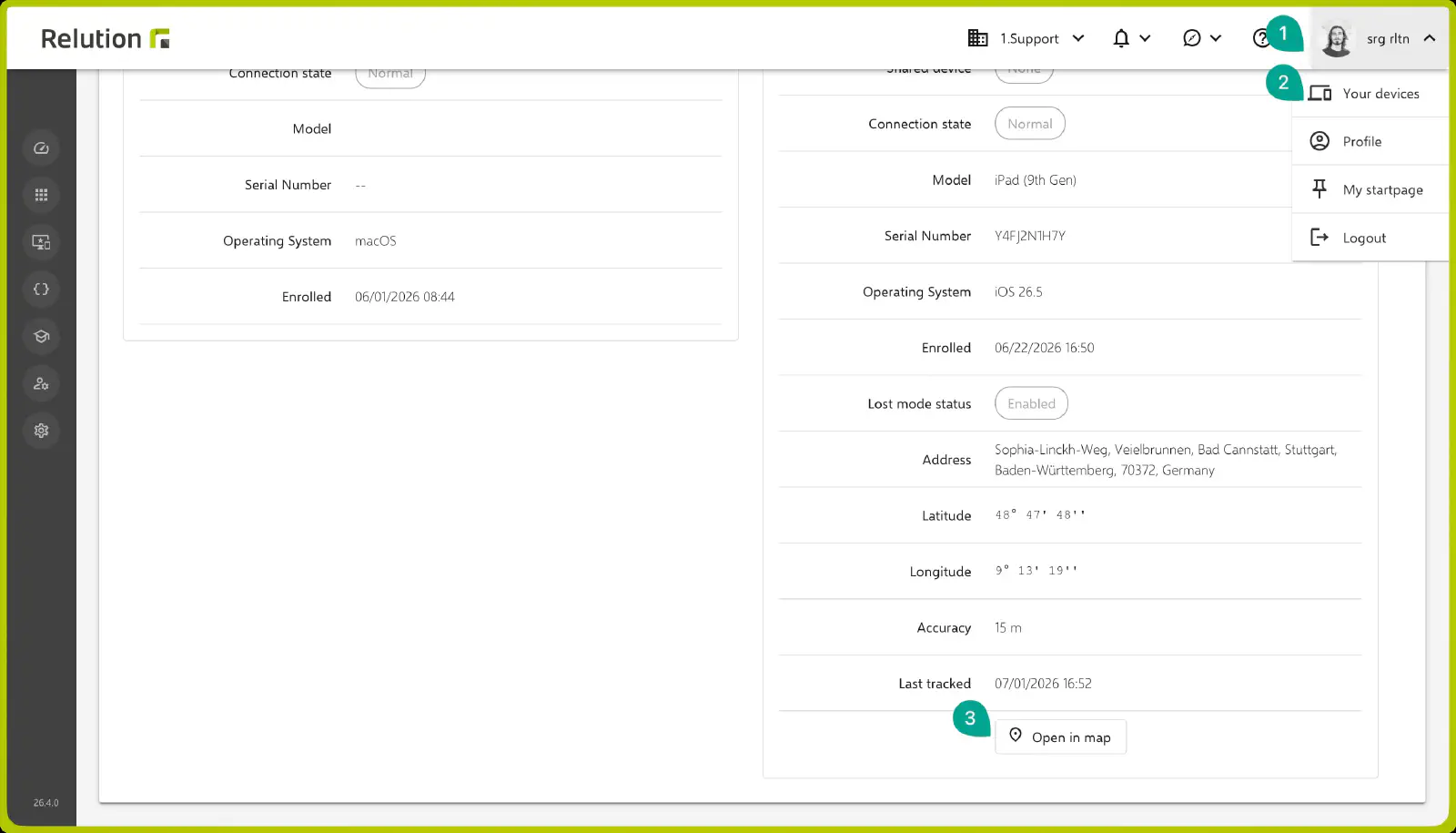
- The profile icon in the top right corner opens Your devices.
- In the relevant device, Open in map in the location section opens the map.
The last known location is then displayed on a map view.
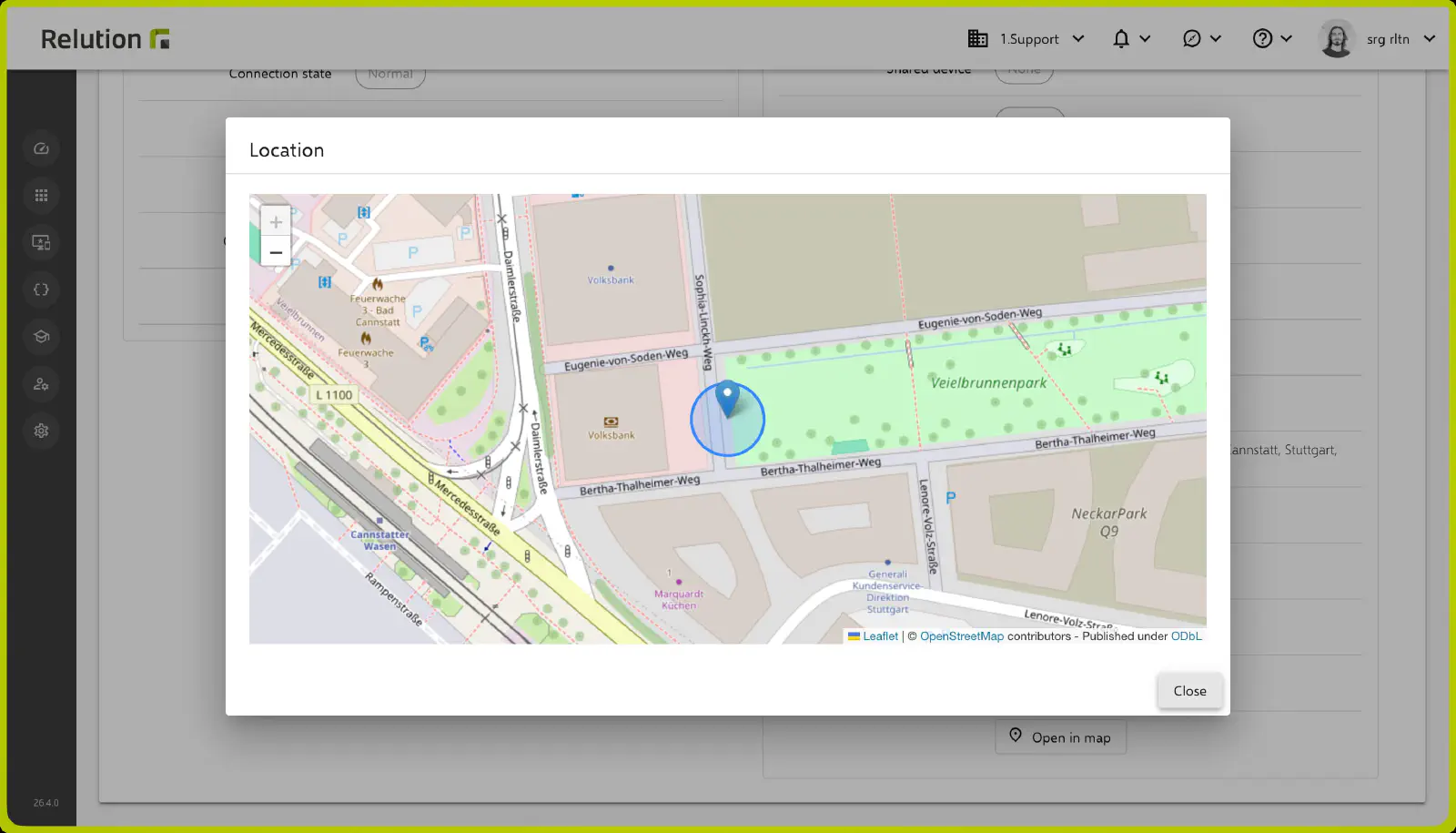
This requires the Read your devices location permission. It is included in Self service portal - full access, but not in Self service portal - read access. Without it, the location section is not displayed. The location section is available for iOS, Android (including Android Enterprise) and Windows devices; on iOS devices only if the device is supervised and lost mode is enabled. No location is displayed for macOS and ChromeOS devices.
For Android Enterprise devices, activated location services as well as the corresponding permission of the Relution Companion are also required; see Locate Android Device → and Location Services →.