 Customer Hub
Secure Mail Gateway
With the Secure Mail Gateway (SMG), Relution offers the possibility to connect to an Exchange server without making it available on the internet. Relution works as a proxy for the communication via Exchange Active Sync (EAS). The use of SMG requires the availability of basic auth on the Exchange server. Modern auth is not supported.
/Microsoft-Server-ActiveSync to the SMG service (port 8093). The SMG service must be able to reach the Exchange server (Exchange URL) and the Relution server. A connection from the Exchange server to the Relution server is not required.It is recommended to configure the restrictions options only after the connection has been successfully tested to exclude possible errors. Once the connection has been successfully tested and one can work with the endpoints, the permissions can be configured accordingly.
Configuration of the Secure Mail Gateway
New in 26.4The settings are located under Settings → Device Management → Secure Mail Gateway. They apply per organization; the tile is not available in the global organization.
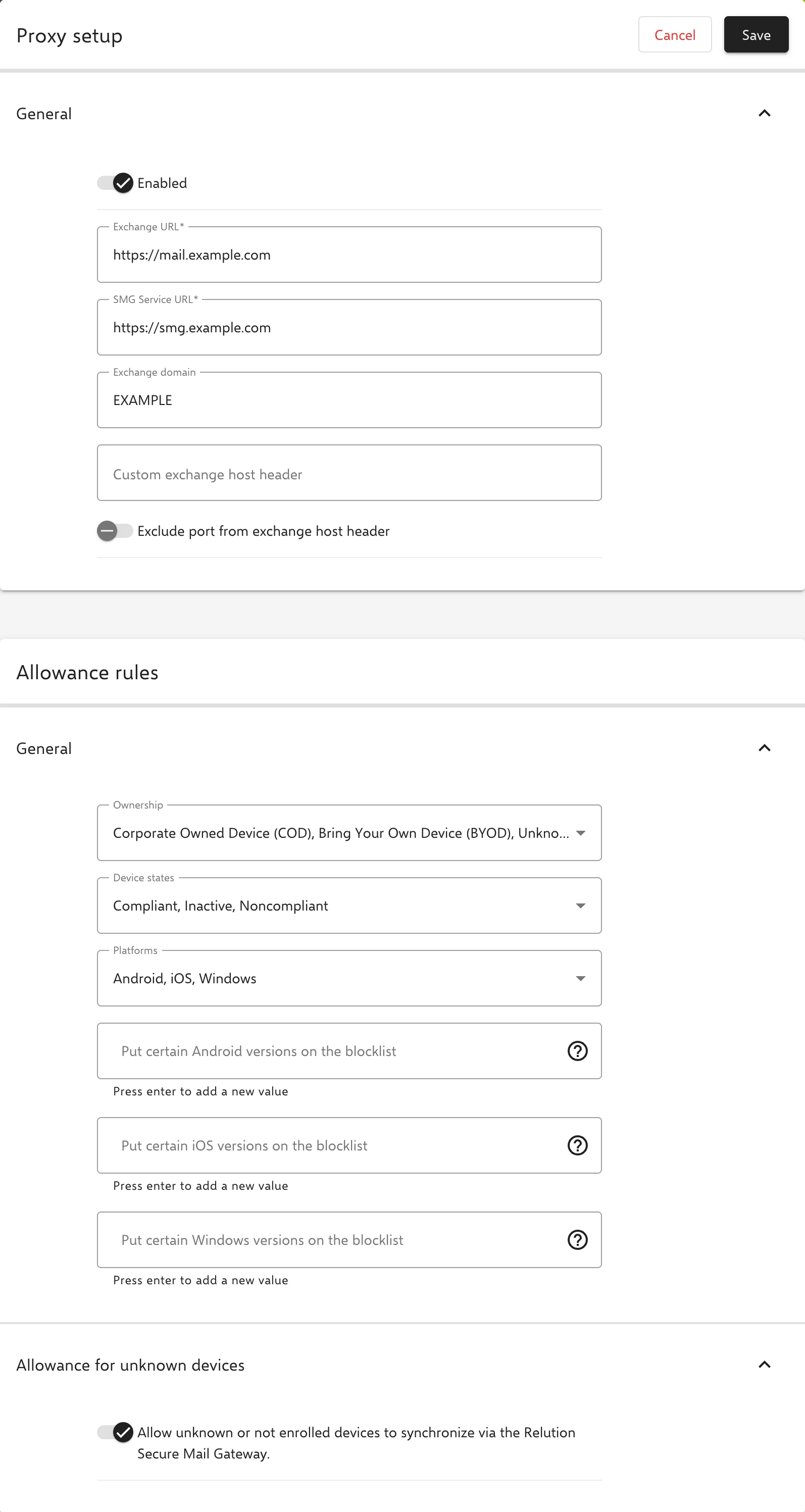
Proxy setup
Enabled Turns on the SMG for the organization. If the toggle is off, the other fields are locked, and the option Use Secure Mail Gateway cannot be turned on in the Exchange configurations of policies.
Exchange URL The address where the Exchange server can be reached. Mandatory field.
SMG Service URL The publicly reachable URL of the SMG service. This can be a dedicated subdomain (e.g.
https://smg.yourserver.example.com) or the same URL as the Relution server — provided the reverse proxy forwards/Microsoft-Server-ActiveSyncto the SMG service correctly.This field is available as of Relution 26.4.1 and is mandatory. If a URL is entered that differs from the Relution server URL, existing Exchange configurations do not adopt the new host automatically. A new version must be created in every policy containing an Exchange configuration. In the Exchange configuration, the option Use Secure Mail Gateway must be enabled so that the host is set to the new SMG Service URL. The policy must then be published.
Exchange domain The corresponding domain of the Exchange server to be accessed. Optional; if set, the SMG uses this domain when forwarding requests to the Exchange server (see Technical overview →).
Custom exchange host header Optional value for the host header used when communicating with the Exchange server. If a value is entered, it replaces the host header that is otherwise derived from the Exchange URL.
Allowance rules
The allowance rules define which devices enrolled in Relution may synchronize with the Exchange server via the SMG. A request is only forwarded if the device meets all rules.
Ownership Allowed ownership types: Corporate Owned Device (COD), Bring Your Own Device (BYOD) and Unknown. By default, all are selected.
Device states Allowed device states: Compliant, Inactive and Noncompliant. By default, only Compliant is selected; inactive and noncompliant devices are rejected.
Platforms Allowed platforms: Android, iOS and Windows. By default, all are selected.
Put certain … versions on the blocklist A separate field appears for each selected platform, e.g. Put certain iOS versions on the blocklist. Devices running one of the listed operating system versions are rejected.
A connection should be established first and the function tested before any restrictions are configured.
Allowance for unknown devices
The toggle allows unknown or non-enrolled devices to synchronize via the SMG, e.g. notebooks or PCs that cannot be enrolled in Relution. A device counts as unknown if Relution cannot match the request to an enrolled device. The option is enabled by default. If it is disabled, enrolled devices may also be rejected during the initial account setup as long as Relution cannot yet identify them.
Use in policies
For devices to use the SMG, the option Use Secure Mail Gateway is enabled in the Exchange configuration of a policy, e.g. for iOS → or Windows →. Exchange Host and Exchange Domain are then set automatically. If the platform or an operating system version is blocked in the SMG settings, the configuration shows a warning.
Technical overview
For Exchange configurations using SMG, the SMG Service URL without the protocol (https://) is set as the server address on the device, so the device connects to the EAS endpoint <SMG Service URL>/Microsoft-Server-ActiveSync. The domain is set to the unique name of the organization. Relution uses the domain to identify the corresponding SMG settings.
If SMG is enabled and configured in these settings, the request headers DeviceId and DeviceType are evaluated to identify the device triggering the request. Depending on the SMG settings, if the device could be identified at all, and the properties and status of the device (see section Allowance rules), the request is denied or forwarded to the Exchange host configured in the SMG settings and the response is delivered back to the device. The domain is adjusted to the one configured in the SMG settings if present.
Password
Exchange and SMG use BasicAuth, here it is possible that account errors may occur on the end device when using special characters such as $ # / * ü ö ä and space.
To check this, a simple password consisting of letters and numbers should be used for testing.
macOS
MacOS uses the Exchange connection via EWS. However, the SecureMailGateway can only forward ActiveSync. Therefore, it is currently not possible to use macOS devices with SMG.