 Customer Hub
Windows Companion
The Relution Companion for Windows is a Windows service that is installed on all Windows devices managed by Relution, except devices running Windows Home Edition and devices whose edition is not recognized. It is not a regular app available in the Windows App Store or the Relution App Store. Relution Companion for Windows has administrative rights, is intended for administrators only, and runs entirely in the background. It does not interact with end users.
Installation
With Relution Server version 5.15, the Relution Companion for Windows is automatically installed on all newly enrolled Windows devices, unless they run Windows Home Edition. If the Windows device is already managed by Relution, the Relution Companion for Windows will be installed automatically as well. On Windows Home, the Companion is not available, and neither are PowerShell scripts or the installation of MSI and EXE packages: Windows Home Limitations →
On the Windows device under Settings, the Relution enrollment Connected to Relution is displayed. In the submenu Info, it is visible that the Relution Companion for Windows has been installed successfully.
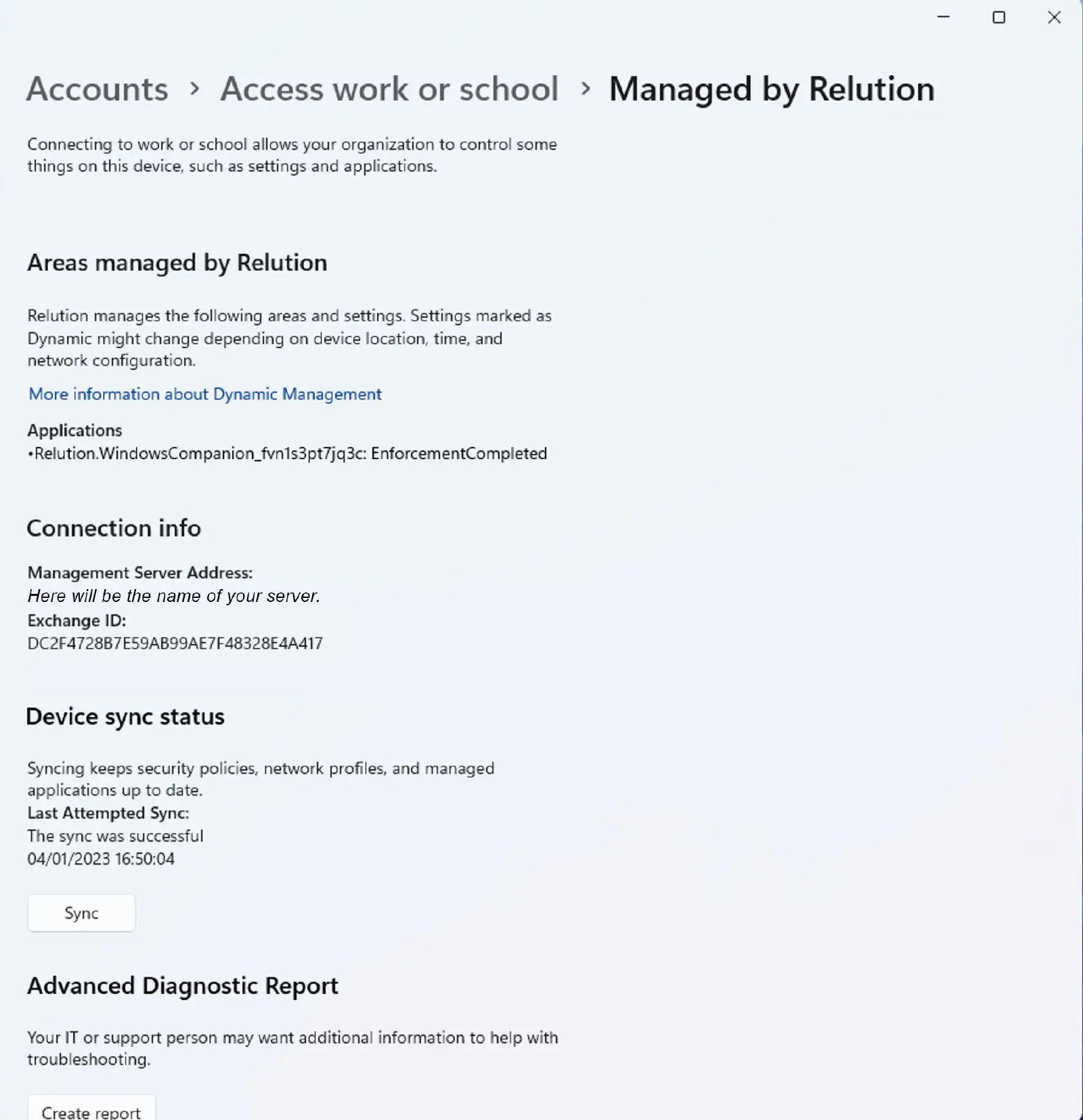
Until the Companion reports to the server for the first time after installation, the device shows the compliance notice “The Windows Companion is not installed!”. If an installed Companion stops responding, this becomes a compliance violation and the Companion is reinstalled. When a newer Companion version is available on the server, the Companion on the device is updated automatically.
If a Windows device is no longer managed by Relution, the Relution Companion for Windows is automatically removed from the device.
Purpose of the Relution Companion for Windows
By default, the configuration of enrolled Windows devices in Relution uses the so-called Configuration Service Providers (CSP), which allow access to certain settings in the Windows system. The configuration possibilities are however limited here. By means of the Relution Companion for Windows, configuration options are significantly extended.
Additional options
With the Relution Companion for Windows, additional one-time Windows-based PowerShell scripts can be executed on enrolled Windows devices via Relution actions.
Another advantage of Relution Companion for Windows is the installation and uninstallation of classic applications in the device context. This allows .msi and .exe files to be installed and uninstalled on enrolled Windows devices via the Relution App Store.
In addition, the following functions run exclusively via the Companion: the installation of WinGet apps, recurring script execution via Windows Script Configuration → and the actions Reset password (Windows), Enable Bitlocker and Disable Bitlocker. The behavior of the Companion itself is controlled by the Configure Companion → policy.
Applying Powershell scripts to Windows devices
PowerShell scripts are text files that contain at least one PowerShell command that is executed by Windows when the file is opened. Processes, both on the computer and at Relution, can be greatly facilitated by this. The script files are written by the administrator and saved with the extension .ps1. Only PowerShell scripts that do not require any user interaction can be executed, since the Relution Companion for Windows runs completely in the background. For resetting forgotten user passwords, the dedicated action Reset password (Windows) is now available.
Since Relution 5.16, PowerShell scripts are managed centrally in Relution. A script is therefore no longer uploaded in the action, but created beforehand under Scripts → Scripts via Add. The default values for Timeout (in minutes) and Environment variables are stored there as well. Selecting a script in the action requires the permission to read scripts; without it, no script list is shown.
To successfully run a PowerShell script on a Windows device, the following steps must be performed:
In the device inventory, the desired Windows device is opened; on the device details page, the Apply action button is clicked in the Actions tab.
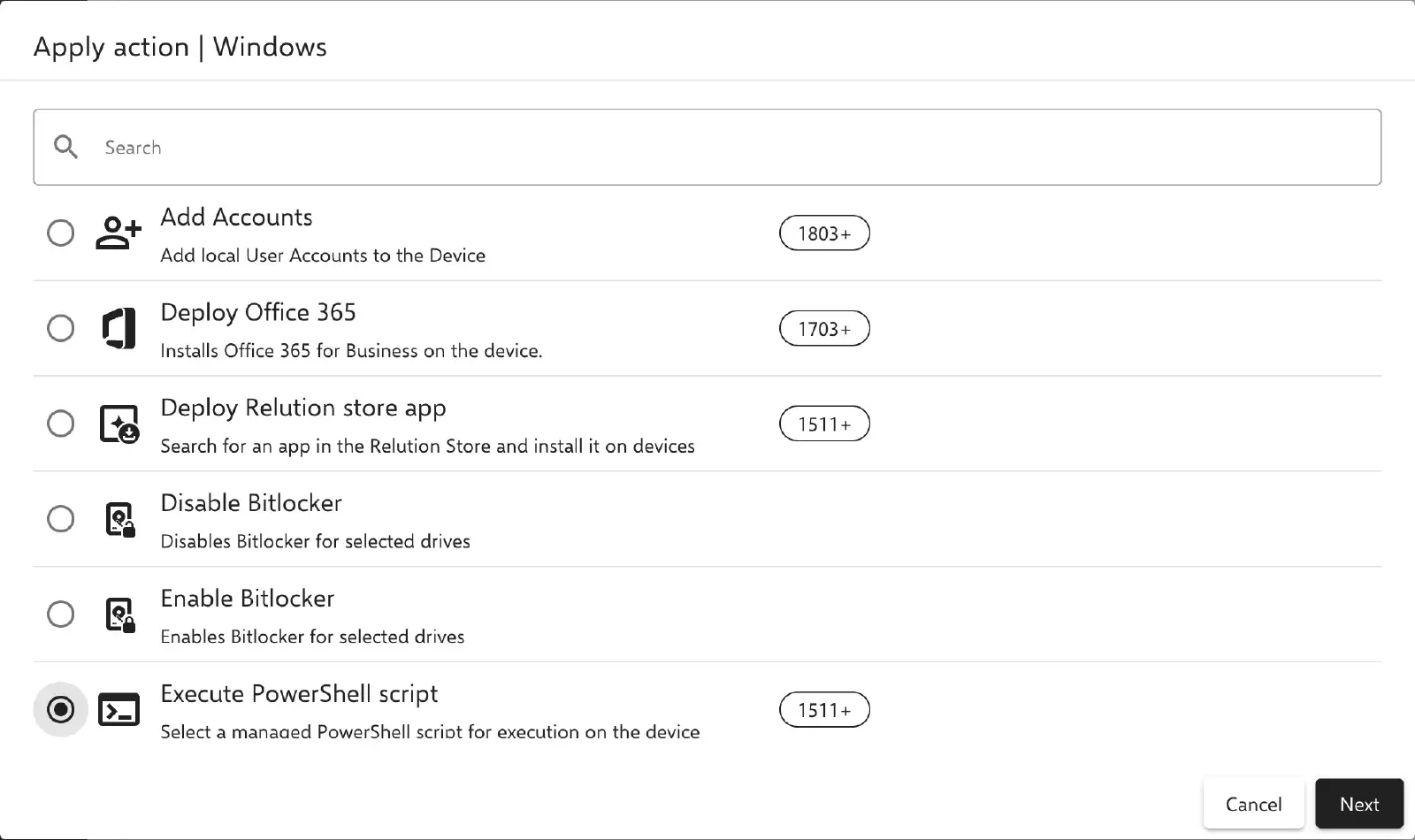
Then the action Execute PowerShell script is selected.
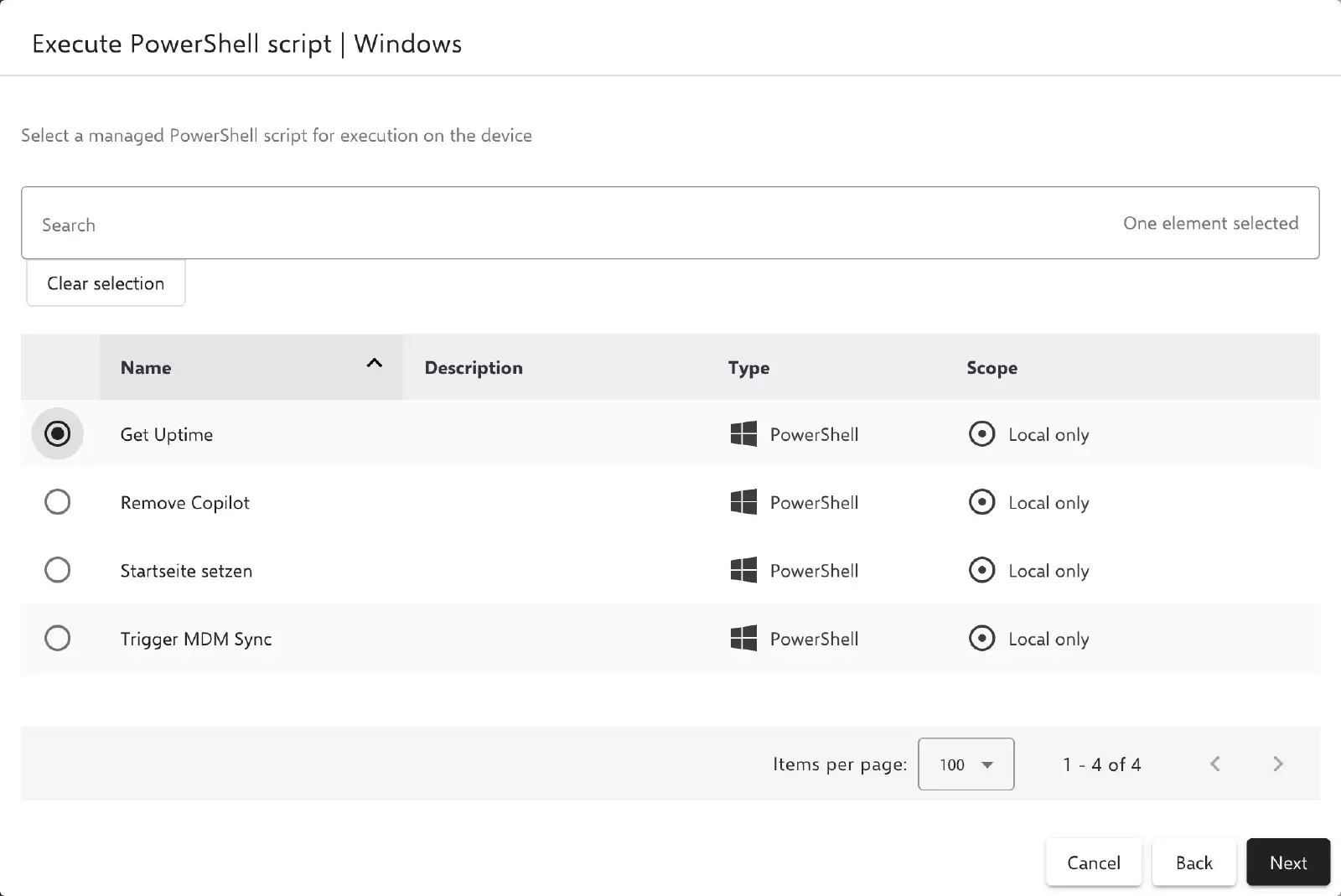
The desired PowerShell script is selected from the list of managed scripts.
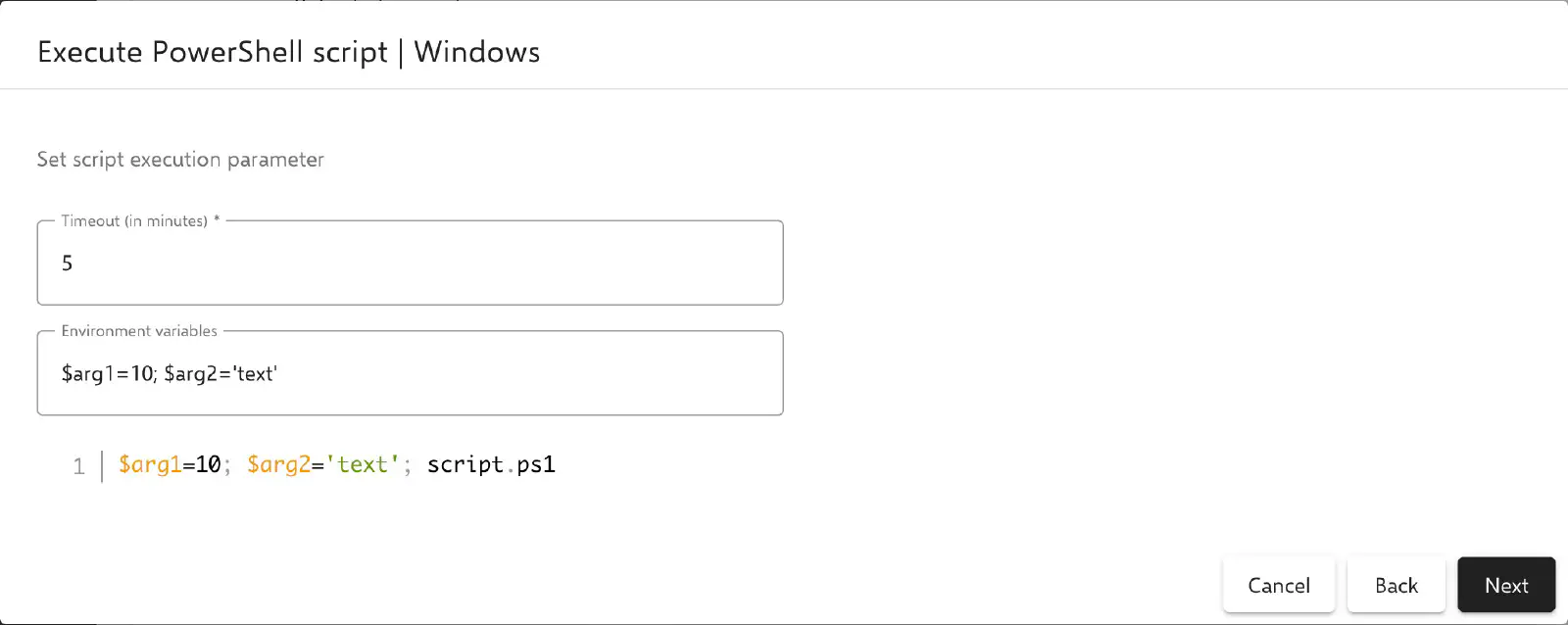
In the second step, Set script execution parameter, the values of the selected script are pre-filled and can be adjusted for this execution:
- The mandatory Timeout (in minutes) field (1 to 30) defines after how many minutes script execution is forcibly aborted.
- The Environment variables field takes variable assignments in the format
$arg1=10; $arg2='text'(up to 512 characters; each assignment except the last one ends with a semicolon). They are inserted at the beginning of the script before execution, and the script can use the variables by name, e.g.Write-Host $arg1.
The executed PowerShell script is listed on the device details page in the Actions tab.
Alternatively, a script can be started directly under Scripts → Scripts via Execute on device. The execution state as well as the result and error output of each execution can be viewed in the history of the respective script under Scripts → Scripts (Show result output, Show error output).